Your predictive AI foundation is the fastest path to agentic AI value
Listen to this article
What if your predictive AI investments could start delivering agentic AI value now? According to DataRobot Chief Product Officer Venky Veeraraghavan and Dell Technologies Senior Director of AI Solutions Brad Maltz, they can. And now is the time to go after it.
Production models, clean data pipelines, optimization engines, and governance controls give agents the grounded business context they need to drive faster decisions and measurable outcomes. An orchestration and reasoning layer can connect these capabilities across teams, systems, and data silos, turning predictions into coordinated action.
In a recent DataRobot and Dell Technologies webinar, Veeraraghavan and Maltz explain how enterprises can build on the AI capabilities they already have and move quickly from predictive insights to agentic outcomes.
Agentic AI activates intelligence your business already has
Agentic AI demos can make the technology feel magical: a chat interface appears to understand any request, navigate an entire workflow, and produce an answer. Inside the enterprise, the opportunity is practical and much closer than it appears.
Predictive AI already handles the hard analytical work. Models generate forecasts, scores, and recommendations within larger workflows that drive business outcomes. People interpret those outputs, consult dashboards, evaluate tradeoffs, run scenarios, coordinate across teams, and decide what happens next. Veeraraghavan calls this layer of interpretation and coordination “human middleware.”
As Veeraraghavan explains, the data and models at the center of these workflows provide the foundation for agentic AI. Agents connect that intelligence to the reasoning, coordination, and decision-making required to produce an outcome.
Agents accelerate the work surrounding the prediction. They interpret intent, break goals into smaller problems, call the appropriate data and analytical tools, synthesize the results, and surface a recommendation or exception to the person accountable for the outcome.
Language models provide flexible reasoning and orchestration. Enterprise data, predictive models, mathematical models, business rules, and optimization systems provide grounded, often deterministic answers. Combined in an agentic workflow, they create an adaptive path from business question to action.
Your existing AI investments already hold valuable intelligence. Agentic orchestration extends that intelligence across the decisions and actions that drive business results.
Three kinds of agentic AI. One offers the clearest path to hard ROI.
Agentic AI creates value at three levels, each with a different degree of impact, measurability, and strategic reach.
1. Productivity agents and copilots
These tools help individuals create presentations, analyze information, write emails, and complete routine work faster. The productivity gain is real, but its financial impact can be difficult to quantify. Saving a few minutes on an email does not translate cleanly into revenue, margin, or reduced risk.
2. Line-of-business agents
These agents accelerate established workflows inside platforms such as Salesforce, SAP, ServiceNow, and Workday. They can process expense reports, resolve service tickets, and complete other structured tasks more efficiently. Their impact is easier to measure, although it typically remains contained within one application, process, or function.
3. Agent workforces
Agent workforces put agents at the center of consequential business workflows. They coordinate data, predictive models, optimization engines, applications, and human expertise around a defined outcome. Their impact can be measured through the business metrics leaders already track, including revenue, margin, operational efficiency, and risk.
Veeraraghavan connects this third category to the growing demand for demonstrable returns from enterprise AI investments. This is where existing predictive AI investments can compound.
Much of the analytical foundation may already be in place, including enterprise data, sensors, models, and optimization logic. Agentic orchestration connects those assets across the workflow, shortening the path from intelligence to decision to measurable business impact.
Agentic AI is already changing operational outcomes
Chevron is applying agentic AI to a high-stakes challenge: protecting people during anomalies at industrial facilities.
IoT sensors detect the anomaly. Models project how the gas plume will move under local weather conditions. An optimization engine directs tasks away from danger. An agentic application brings these capabilities together, allowing operators to evaluate scenarios and coordinate a response in near real time.
Speed matters. Electrical and mechanical drones can cause issues in areas with hazardous gases, while sending people into the affected area creates additional risk. Agentic orchestration gives operators a faster way to determine where the gas is moving, which equipment can operate safely, and how the response should adapt.
A technology company is applying the same pattern to supply-chain volatility. Quarterly forecasts and planning cycles could no longer keep pace with shifting demand, new technologies, logistics constraints, and changing customer priorities.
The company uses an agent to orchestrate its existing predictive models, what-if analysis, and optimization tools. A planner can evaluate what happens when inventory moves to another customer, compare delivery times and profit margins, and optimize for competing priorities such as meeting quarterly targets or protecting strategic accounts. Supply-chain and sales operations teams can then assess disruptions together and respond faster.
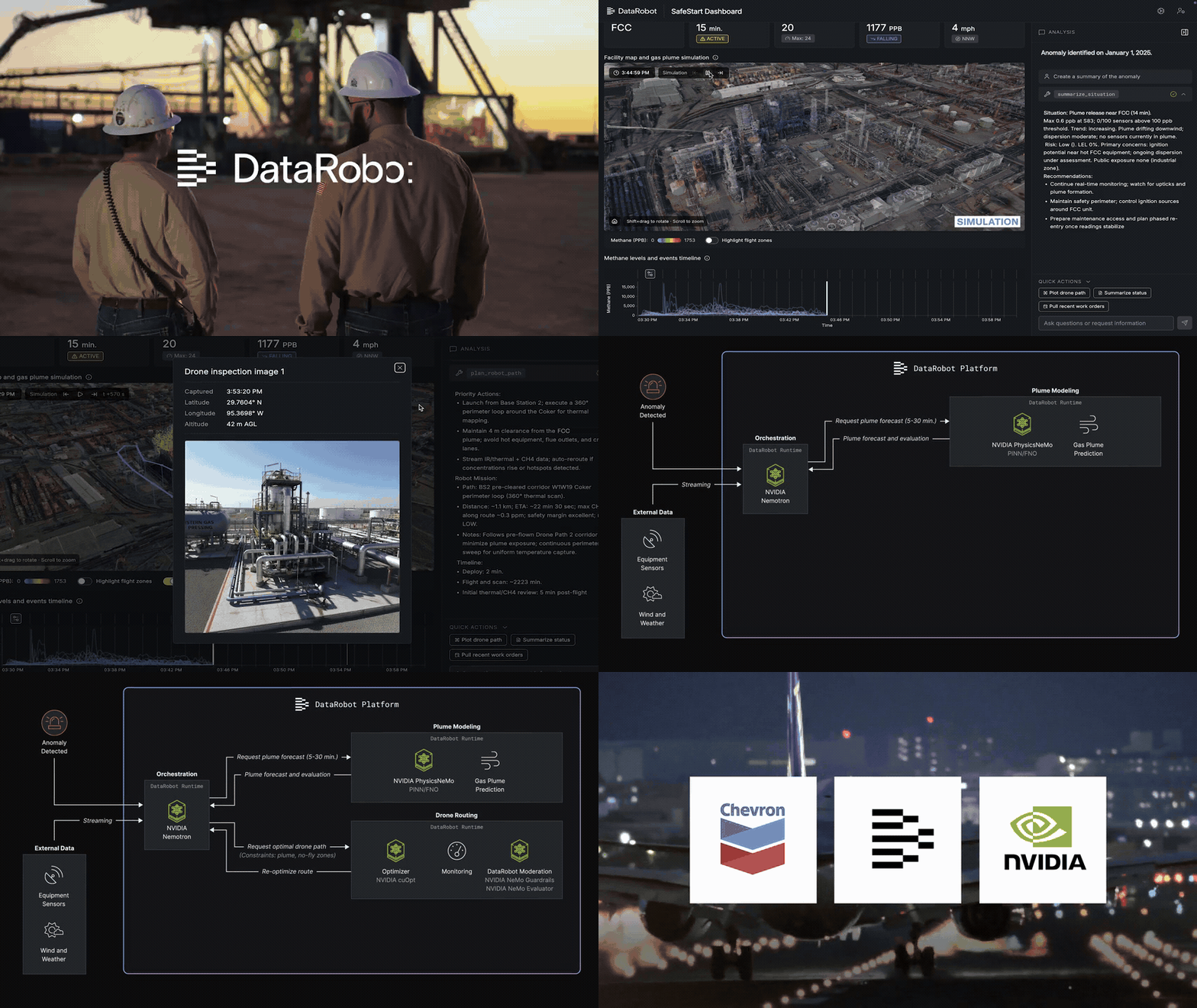
Both examples build on capabilities already in place: enterprise data, sensors, predictive models, and optimization logic. Agentic orchestration connects those assets in a responsive decision system, accelerating the path from signal to analysis to action.
Three things to get right as you make the transition
Moving from predictive to agentic AI requires clear decisions about where to invest, how to architect the system, and which opportunities to pursue. These three principles can help enterprises focus resources on measurable value while building the flexibility to evolve.
1. Think value, not tokens
A cost strategy should start with two questions: What should run, and where should it run?
The answer may combine frontier and open-weight models across cloud, on-premises, deskside, and edge infrastructure. A complex reasoning task may justify a frontier model, while a smaller open-weight model may handle a simple, repetitive step more efficiently. Data sensitivity, latency, quality, and control all shape the economics. Maltz noted that, for some workloads, on-premises or deskside approaches can reach break-even against hosted environments within months.
2. Build a model strategy, not a model choice
The model landscape is changing too quickly to make one provider or model the permanent answer to every task. Treat models as a portfolio. Route each request according to the criteria that matter for that step, including quality, cost, latency, data sensitivity, and deployment requirements.
This approach also keeps the architecture open to improvement. A predictive model can remain a tool the agent calls today and be replaced later when a better option emerges. The workflow continues delivering value as its individual components evolve.
3. Pick outcomes, not processes
The highest-value opportunities often span several teams, systems, and data silos. Consider outcomes such as responding to a supply-chain disruption, completing a know-your-customer review, protecting plant safety, or optimizing a tariff decision.
Work backward from the outcome. What data grounds the agent? Which models, applications, and business rules must it call? What actions can it take? Where should a subject-matter expert approve, intervene, or handle an exception? These questions reveal where agentic orchestration can produce meaningful business impact.
Build on the foundation already in place
Enterprise readiness for agentic AI already exists across production models, governed data, domain expertise, business applications, infrastructure, and years of operational learning. Connecting these capabilities around a high-value outcome creates a practical path forward.
Start with predictive systems you trust and make them available to agents as tools. Add controls, observability, and human oversight. Measure performance through business outcomes, then improve individual components as the workflow evolves.
DataRobot’s recognition as a Leader in the Gartner® Magic Quadrant™ for Data Science and Machine Learning Platforms for the third consecutive year reinforces the maturity of this foundation. Production-grade agentic AI is ready to move from experimentation into consequential business workflows.
Enterprises with useful predictive models and trustworthy data may already have the foundation they need. Agentic orchestration can turn those investments into coordinated action and measurable value.
Watch the full DataRobot and Dell Technologies webinar to learn how enterprises can build on their predictive AI investments and move toward agentic workflows that deliver measurable business value.
Get Started Today.