The unsexy AI: why your forklift matters more than your chatbot
Your forklift breaks down at 7 a.m. Your best technician is 40 minutes away. Nobody has even checked whether the part is in the warehouse yet. By the time someone finds the manual, confirms the part, and gets a dispatcher moving, half a shift is gone and the SLA clock is still running.
Nobody’s building a demo around that.
Every agentic AI pitch in your inbox right now is about something else: an agent that drafts your sourcing emails, summarizes supplier contracts, or writes better product copy. All useful. But none of them help when the oven in your industrial kitchen goes down, the excavator on your job site won’t start, or the truck carrying a customer’s order breaks down on the interstate.
That’s the gap. Some of the most valuable AI use cases in manufacturing aren’t particularly glamorous, and they’re easy to overlook.
The math nobody puts in the deck
More than six in ten manufacturers experienced unplanned downtime in the past year, costing the sector as much as $852 million a week. At an average cost of $1.7 million an hour, a single incident can run as high as $42.6 million, according to a 2025 global survey from Fluke Corporation and Censuswide of 600 manufacturers in the US, UK, and Germany.
And it’s not for lack of trying.
L2L’s October 2025 survey of more than 600 manufacturing leaders found that 60% lose more than $250,000 a year to preventable downtime. Facilities average 30 hours of downtime a month, with more than half of it unplanned. And while 93% of respondents said they’d taken action to address it, only 46% saw a measurable improvement.
That’s a pretty big gap between the effort going in and the results coming out.
The difference can be significant. In Aquant’s 2025 Industrial Machinery Service Benchmark Report, leaders fix problems on the first visit 87% of the time and resolve them in an average of two days. Bottom performers take eight days, at nearly eight times the cost per event. The report points to agentic AI built for the complexity of industrial service as one factor separating the two groups. The alternative is still a lot of calls, handoffs, and people trying to find the right information.
Why the boring problem can be the profitable one
There’s a reason the flashy use cases get the demos while the unglamorous ones carry a much bigger bill.
Sourcing emails and contract summaries are relatively self-contained. Asset uptime isn’t.
Fixing an equipment problem might mean:
- Checking whether the right part is in inventory
- Finding a qualified technician
- Routing the right dispatcher
- Pulling the relevant information from equipment documentation
- Getting the whole process moving before the truck leaves the lot
- Working across the ERP and on-premises systems the plant already runs
That’s a harder problem to solve. It’s also where the financial impact can be much bigger.
One critical piece of equipment sitting idle for an extended period can become a million-dollar-a-day problem at Fortune 500 scale. Across those companies, that can add up to a trillion-dollar issue. Solve it, and the payoff is tangible: fewer trucks making repeat trips, less capital tied up in idle equipment, and fewer SLAs quietly slipping.
DataRobot has built this kind of approach for manufacturing and industrial customers. Instead of asking one generalist agent to do everything, the work is broken into agents that each handle a specific part of the workflow:
- One agent handles inventory
- One handles dispatcher qualification and routing
- One reads equipment documentation to help diagnose the fault
Working together, those agents have increased first-time fix rates by 50% to 60% for customers running the solution. That’s the kind of improvement that can move a service organization from spending days resolving an issue to getting the equipment back up and running much faster.
Marc Amarillas, Director of Customer Success Engineering at DataRobot, walked through this setup on a recent Supply Chain Now webinar with host Scott Luton, co-host Kim Reuter, and me. The conversation focused on what it takes to move agentic AI from pilot to enterprise scale.
His point was simple: an asset going down can be a “million-dollar-a-day problem” at a Fortune 500 company. Across the number of critical assets those companies operate, that becomes a much bigger issue.
The same pattern shows up in working capital
Physical assets are the clearest example, but they’re not the only one. The same math shows up anywhere a manufacturer’s money is exposed while people are trying to figure out what to do next.
On the same webinar, I shared how a tariff and labor signal put one global manufacturer at $2.5 billion in revenue at risk, essentially overnight.
The old process was slow: size up the exposure, check every supplier tier, model possible responses, and decide what to do. That could take weeks.
DataRobot built five agents for the customer, integrated with SAP, to handle that work. The agents detected the signal, quantified the exposure, modeled three responses, and helped reallocate resources globally, with a human approving every step.
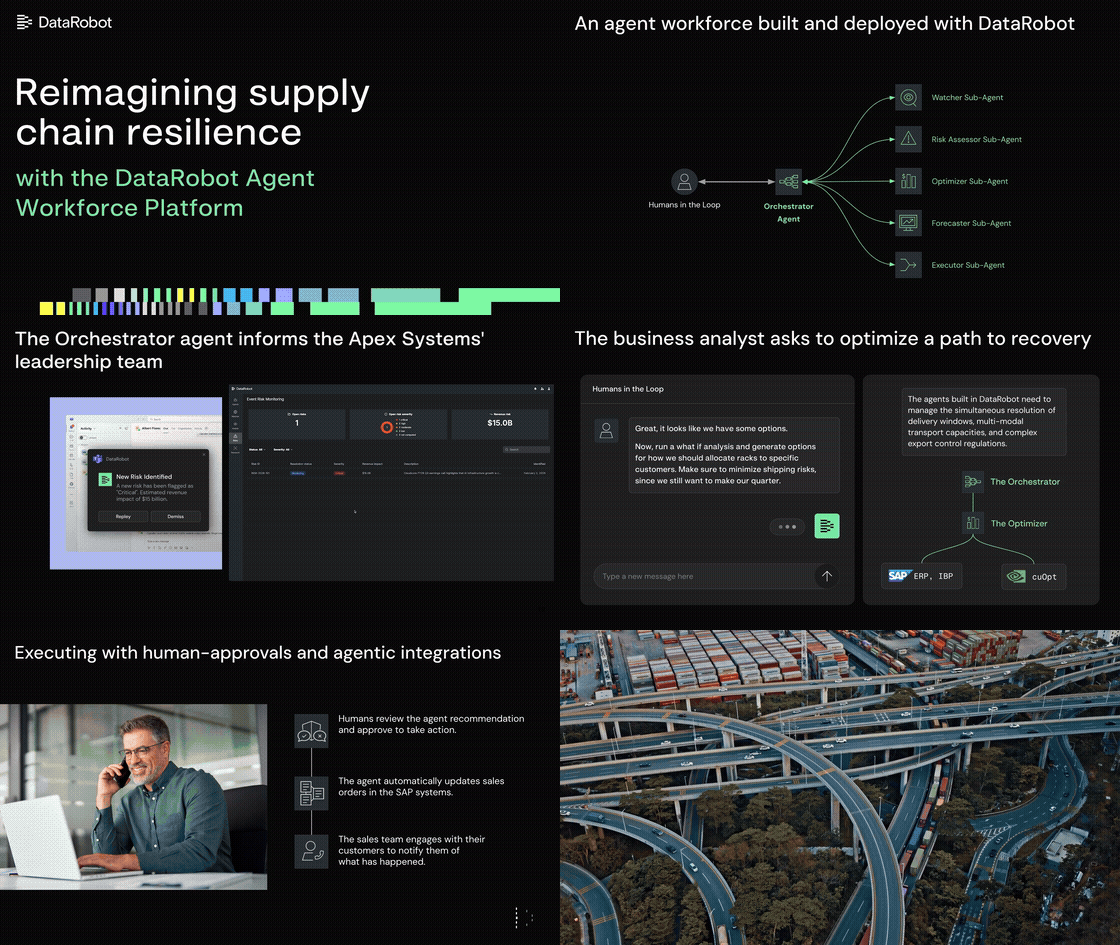
The result:
- $2.5 billion was secured
- $150 million was captured
- The work was completed in 72 hours instead of months
The use case is different from asset management, but the approach is the same: find the expensive problem, break the workflow into manageable pieces, and keep a person in the loop when a decision is difficult to reverse.
It only works if it fits the plant you already have
None of this matters if the technology can’t run where a manufacturer’s data already lives.
Most manufacturers have infrastructure commitments they can’t simply walk away from: SAP, specific cloud environments, and on-premises systems holding sensitive supplier and customer data. An agent that requires everything to move to a new environment before it can help isn’t going to get very far.
That’s why DataRobot supports the same deployment and governance approach across managed SaaS, private cloud, self-managed, and fully air-gapped environments, while integrating with the SAP, ERP, and on-premises systems manufacturers already use.
As I put it during the webinar, the AI should come to the supply chain owner wherever they need it to run, not the other way around.
That’s an important difference between an agent that stays a demo on someone’s laptop and one that an IT and security team will actually allow to work with production data.
Start with the problem that’s already costing you money
You don’t have to bet the whole operation on AI at once.
Start with the workflow where the cost is already visible on the P&L, whether that’s an idle asset, exposed revenue, or another problem that’s taking too much time and money to resolve.
Build an agent workforce around that one problem first. Deploy it inside the systems you already have. And build the governance and audit trail in from day one, rather than trying to add them later.
The chatbot use cases will keep getting the headlines.
But the forklift, the oven, or the tariff signal nobody caught until Monday morning? That’s where a lot of the real money is sitting.
Start there.
Ready to tackle the problem that’s costing you?
See how DataRobot can help you build and deploy agentic AI around the supply chain workflows that matter most to your business.

Get Started Today.