Sovereign AI is an architecture decision
What happens when the infrastructure your entire AI stack runs on becomes a liability? Not because it failed but because the politics around it changed.
For a growing number of enterprises, this isn’t hypothetical. Regulatory requirements are tightening. Data residency rules are multiplying. Governments are intervening in which AI tools can be deployed, by whom, and where.
And organizations that built their AI operations entirely on a single cloud provider’s platform are discovering a hard truth: they can use the tools, but they can’t guarantee they’ll keep using them. They can run workloads in a provider’s sovereign region, but they can’t separate the software from the provider who owns it.
It’s access on someone else’s terms, subject to someone else’s jurisdiction.
Most enterprises evaluating sovereign AI ask whether their cloud provider has a sovereign region. That’s a starting point. But the question that actually reveals your exposure: can your AI software run on infrastructure you fully control, with no dependency on the vendor’s cloud?
Sovereign regions have a ceiling
Cloud providers have responded by standing up sovereign regions: data centers in specific countries where data stays local and falls under local jurisdiction. It’s becoming table stakes, commoditizing fast as hyperscalers race to plant flags in regulated markets.
For a narrow definition of sovereignty, that may be enough.
But the enterprises facing the hardest sovereignty requirements are asking different questions.
- Can a policy decision made in another country interrupt their AI operations?
- Does their AI software supply chain run through a jurisdiction they don’t control?
- Can they guarantee operational continuity if their vendor’s relationship with a government changes overnight?
Sovereign cloud regions can’t answer those questions. A sovereign region still runs on the cloud provider’s infrastructure, governed by their software, subject to their jurisdiction. Moving to a sovereign region changes where the data sits. It doesn’t change who controls the software stack above it.
Sovereignty has levels. Most enterprises are stuck at the bottom.
Sovereignty is a spectrum. At the lowest level, the requirement is straightforward: data stays in a specific geography. A cloud provider’s regional data center handles that. Most enterprises stop here and assume they’re covered.
But sovereignty requirements escalate. The next level asks whether the organization can operate independently of the provider. No third-country interference. No dependency on a vendor’s network, model registry, or update infrastructure. Above that, the question becomes whether any single vendor controls the software, the supply chain, or the AI system’s operational continuity.
Many enterprises, when they honestly assess where they sit on this spectrum, find themselves at the bottom. Data is in the right country, but the AI software still runs on a vendor’s platform, governed by that vendor’s infrastructure and update cycle. Operational continuity depends on that vendor’s continued access to the market.
The gap between where most enterprises are and where regulated industries need to be is architectural. The AI software is engineered to run on the provider’s cloud, and sovereign regions are a patch applied to that architecture: they extend reach without changing the dependency.
Fused vs. decoupled: the architecture decision that sets your sovereignty ceiling
There are two fundamentally different ways to build an AI software platform.
The fused architecture is what hyperscalers build and sell. The AI software, the models, the governance tooling, the agents: all of it is built into the provider’s platform. Some of it now runs on-premises or even air-gapped, but only on the provider’s own hardware stack, with the provider’s models and a curated subset of services. Wherever it runs, the software above the infrastructure line still belongs to the provider.
The decoupled architecture separates the AI software layer from the infrastructure entirely. The platform (agents, governance, MLOps, model registry) runs as a portable layer that drops onto whatever infrastructure the enterprise controls. On-premise. Air-gapped. A virtual private cloud. A partner’s hardware. The same platform and the same governance run in every environment.
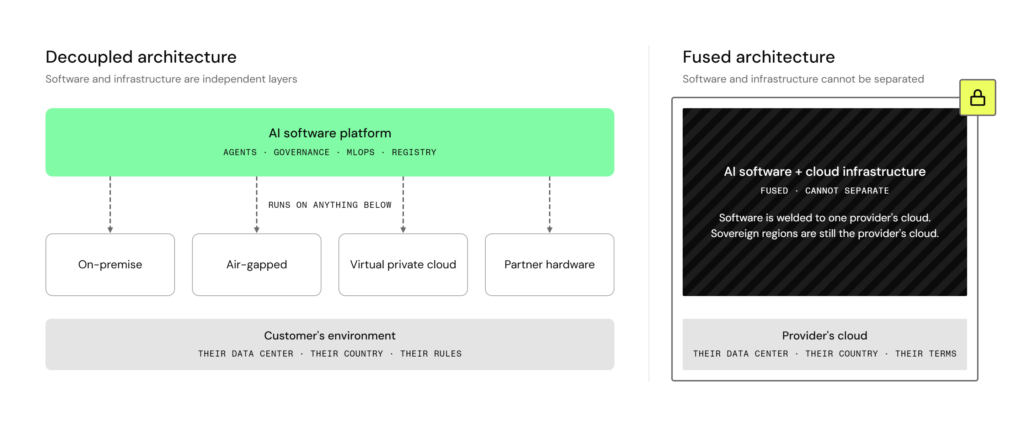
At the bottom of the spectrum, where the requirement is data residency, both architectures compete.
As sovereignty requirements escalate toward operational independence and full supply chain control, only the decoupled architecture qualifies. The fused architecture hits a structural ceiling it can’t engineer its way past.
Every industry has a sovereignty exposure
One of the most persistent misconceptions about sovereign AI is that it’s a public-sector concern. Government contracts, defense procurement, regulatory compliance. While these are very real sovereignty use cases, they’re also a fraction of the exposure.
Any enterprise that has built workflows, products, and operational dependencies on a single provider’s platform has a concentration risk. If anything disrupts that provider relationship, whether regulatory, geopolitical, or commercial, the enterprise has no ability to respond independently.
That’s a business continuity issue, and it belongs in the same conversation as supply chain resilience and operational redundancy.
The economics point in the same direction. At sustained inference volumes, owned or dedicated GPUs often cost less than on-demand cloud capacity. Sovereignty and cost efficiency are converging on the same answer: run AI on infrastructure you control.
Every enterprise runs on some mix of cloud, on-premise, and hybrid infrastructure. An AI platform that can move across all of them, without rebuilding governance or renegotiating vendor relationships, is both a sovereignty property and a business resilience property.
Two questions to ask every AI vendor
Most vendor conversations about sovereign AI focus on geography: which regions, which data centers, which countries. That tells you where the data sits. It tells you nothing about the architecture above it.
Two questions cut through that:
- If your company lost access to a market overnight, could your AI operations continue uninterrupted?
- If you needed to run the platform completely air-gapped from the vendor’s network, could you? And what would you lose?
The answers will separate vendors whose AI software is portable from vendors who have bolted sovereign features onto a cloud-dependent platform. The difference becomes obvious fast.
What sovereign AI actually requires
Sovereign AI at the levels that matter for regulated enterprises is an architectural property of the software. The platform can either run independently of any single infrastructure provider, or it can’t. No amount of sovereign regions changes that.
A decoupled platform runs on infrastructure the enterprise already owns or selects independently. The platform is designed to stay the same when the infrastructure underneath changes. That’s the difference between a platform you depend on and a platform that works for you.
For organizations in energy, manufacturing, defense, and any enterprise whose sovereignty requirements extend beyond data residency, the honest assessment is that a fused cloud platform has a ceiling. A decoupled architecture doesn’t.
(CTA) The architecture decision you make today locks in your operational control for the next decade. The enterprise agentic AI architecture framework covers the governance, deployment, and runtime decisions that determine how much control your organization retains.
Get Started Today.